

Imagine you're a hiring manager sorting through countless CVs. Each one competes for attention, but only a select few leave a lasting impression. A successful CV goes beyond mere facts; it tells a cohesive story of your career progression, skills and accomplishments. From formatting to content, every detail plays a crucial role in shaping the perception of your candidacy.
Without further ado, here's a blueprint of a CV.
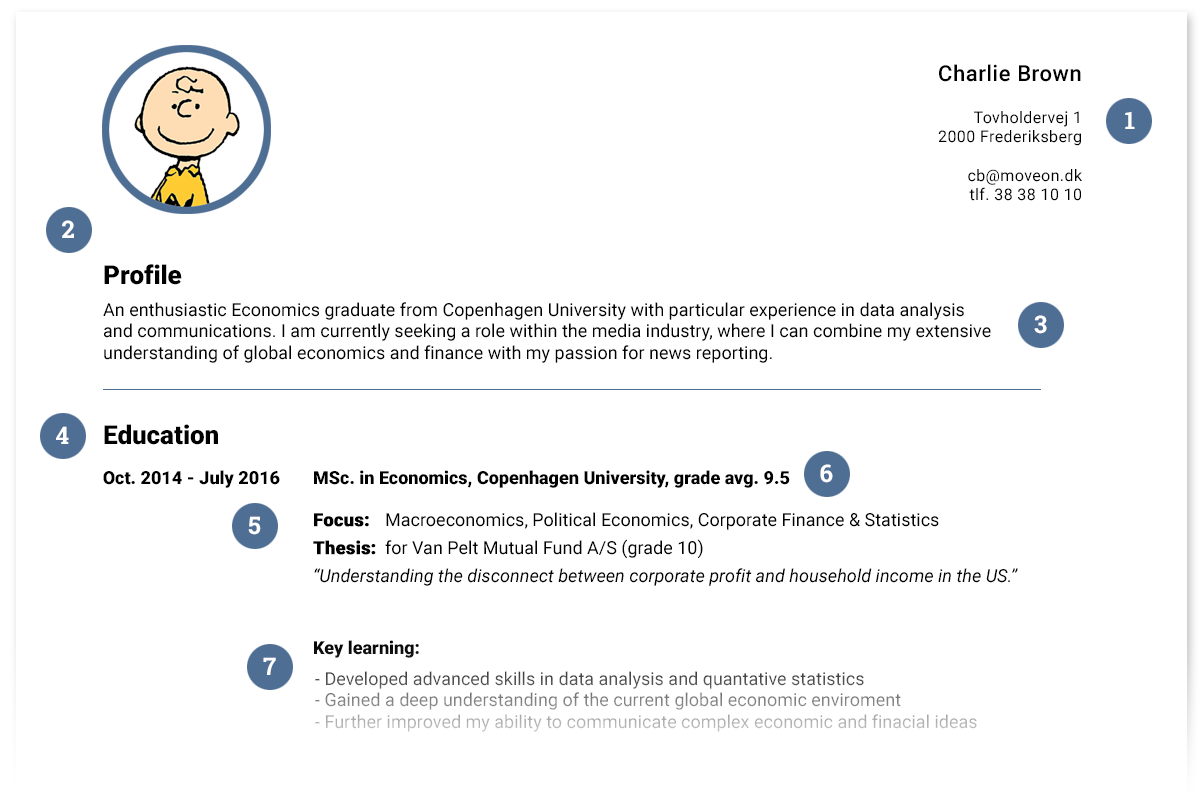
1. Contact Information
Make sure your name and contact details are clearly visible and correct. There is no need for unnecessary headlines such as “Name:” and “Address:”. Instead use font size to clearly differentiate these.
Age & Marital Status
Think carefully before including your marital status, age, health or anything similar. Do these details sell you as an applicant? If you are applying in Denmark as an international candidate, it can be useful to include your location, language skills and whether you already live in Denmark or are relocating. Never include sensitive personal details such as CPR number, passport number or similar.
2. Headlines
Clearly break up the information on your CV and guide the reader with headlines, spaces and different fonts.
Photo?
CVs in Denmark are often likely to include a photo. If you have a professional looking photo, including it can be a nice way to personalize your CV. It is not a requirement, so only include one if it supports the professional impression you want to give.
3. Profile
This paragraph should be like an elevator pitch summarizing who you are and why the employer should hire you. It should be tailored to the role and employer, concise and not cliché. Evaluate each phrase you write, asking yourself: do I need this many words to get across the same idea? Do I sound confident in myself? Could I be using an adjective to differentiate myself and be persuasive? Could every other applicant for this role write the same thing that I am writing?
If you are applying for jobs in Denmark in English, you can also use the profile to briefly show your connection to Denmark, your willingness to learn Danish if relevant, and the professional value you bring to the role.
4. Education or Experience first?
As a student or young graduate it is likely that your most significant skills and experience will come from your education. This will probably be the same for your competition, so your employment, extracurricular activities and voluntary experiences will play a significant role in differentiating you from the other candidates. When ordering your CV think carefully about what is most impressive or interesting for the employer and put that at the top.
5. Focus
Don’t simply choose all your subject areas but instead describe the areas that you think are relevant for the job.
Read the job advertisement carefully and use the same professional language where it fits your actual experience. This is especially important if the employer uses digital screening tools or AI-supported recruitment systems.
6. Grades
If your grades are good and relevant, then share them. If your degree, grading scale or university is not well known in Denmark, add a short explanation where it helps the employer understand your level.
7. Key Learning
What is it that you bring to the employer from your past experiences? Focus on methods, tools, projects, analysis, research, collaboration and other skills that are relevant to the job.
8. Company Description
If it is not clear and you think it adds to your CV, you can include a description of the company, for example “Financial Services Firm, +100 employees”. Alternatively, you could work these details into the responsibilities section.
This can be especially useful if your previous employer, university or job title is not familiar to Danish recruiters.
9. Responsibilities
Only include those responsibilities which add something to your CV and make you more attractive in the eyes of the employer. If you’ve had similar responsibilities in different positions, try to avoid duplicating what you write on your CV. Emphasise a different aspect, show your breadth of experiences and development towards where you want to be.
10. Font
Always think about whether the type and size of your font is easily readable for others. Keep the layout clear, simple and easy to scan. Avoid hiding important information in graphics, icons or unusual formatting.
11. Results
Your relevant successes and where you made a difference should be included, particularly if they are concrete examples or your work was recognized in some way.
12. Additional
Only include what demonstrates a competency, knowledge or accomplishment that the employer might see as desirable.
13. Sports, reading, chess, foreign travel etc.
“An interest in world food and skiing” does little to demonstrate a competency and serves more as clutter that detracts from your professional message. Consider carefully which interests present valuable data about you to the potential employer.
14. Skills
This is best as a section about your hard skills. Your soft skills should be apparent from your responsibilities and achievements. Consider whether very common skills, such as Microsoft Word and email, add to your offering. If you’ve been to university, or you can program in C++, the employer can safely assume you have basic computer skills.
Relevant skills may include languages, software, methods, certificates, project management, data analysis, laboratory techniques, programming languages, design tools or industry-specific knowledge. For English-speaking jobseekers in Denmark, language skills should be clear and honest, including your level of Danish if you have one.
15. References
Generally it is assumed that you will be able to provide references upon request. You do not need to include full contact details for references directly in the CV unless the employer asks for them.
16. Links to your online profiles
Make sure to include up-to-date sources, like LinkedIn, GitHub, Behance, a portfolio, publications or similar. Focus on the ones with immediate relevance to the job at hand.
Also make sure that your LinkedIn profile supports the story in your CV. Danish recruiters often use LinkedIn, so your profile should be updated, professional and consistent with your application.
17. Need more advice?
You can find more advice on writing a CV for Denmark at Workindenmark.